
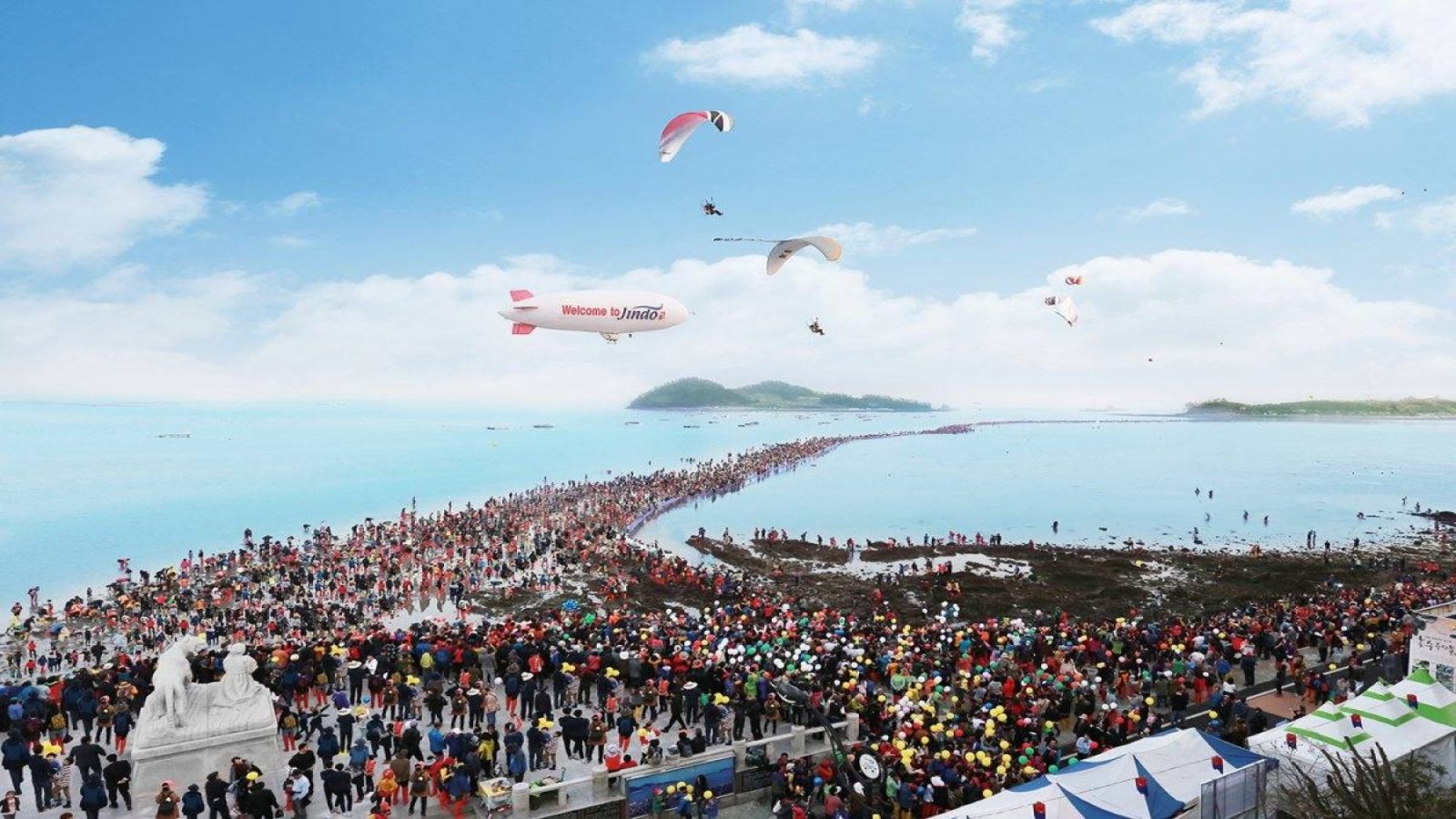

Once every other month, a breathtaking and mysterious event turns the ocean along South Korea’s southern edge into a walking route. Between Modo Island and Jindo Island, the sea opens for approximately an hour to expose a ribbon of land some 2.8 kilometers wide. Also called the “Jindo Miracle Sea Road,” the wonder attracts tens of thousands of tourists who gather to see and walk on this temporary road. Conjoining science, culture, and myth, Jindo sea parting is one of the most fascinating seasonal miracles of South Korea.
How Tidal Science Explains This Stunning Phenomenon
Though it might appear to be from a biblical epic, Jindo to Modo’s tidal path is no mystical miracle—just an accident of tidal forces. It is a product of what scientists refer to as “tidal harmonics.” The combination of the sun and moon’s gravitational pulls, Earth’s rotation, and seafloor topography in the area all combine to create extremely low tides at certain times of the year.
These extremely low tides usually take place between March and June. For this short period, the outgoing tide leaves a strip of land 40 to 60 meters in width exposed. The natural causeway is navigable for a period of about one hour before the water separates it again across it. For a brief period, tourists can walk from Modo Island to Jindo and back upon what seems a concealed road that only comes into existence when the traveler is aware of where to look.
A Local Legend: Grandma Bbyong’s Story
Besides the scientific reason, the phenomenon has roots in Korean legend. It is said that Grandma Bbyong was left behind when villagers escaped a tiger attack on Jindo Island. Her family escaped to Modo Island, while she was left behind. She prayed earnestly to the Dragon King of the Sea to let her be reunited with them. Compassionate to her prayer, the sea parted miraculously to create a path for her to walk along.
She went through the sea to be with her own, and upon reaching them, died peacefully. A statue was erected nearby as a remembrance in honor of her legacy at the road foot on Jindo Island. The narrative ascribes emotional depth to the natural phenomenon and accounts for how sea parting is commemorated and also as a memorial.
The Miracle Sea Road Festival: Culture Meets Nature
South Korea welcomed this unicum with an annual holiday known as the Miracle Sea Road Festival. The festival is typically held during spring, at the same time as the tides reveal the land bridge. It’s not just about walking across the sea; it’s a full-fledged cultural bash involving traditional music and dance performances, parades, traditional folk art, and traditional cuisine.
During the festival, Jindo town is filled with animation as the villagers and visitors alike witness what in local parlance is called “the Moses Miracle” of Korea. Drum and dance performances, elaborate costumes, and cultural exhibits are the backdrop to the sea walk, a technicolor blending of nature and human endeavor. Blending tidal science and culture, the festival is globally distinct.
Walking Between Islands: A Symbol of Union
Walking the sea road is not a tourist stroll—it’s a lesson in reflection. To others, it’s a symbol of togetherness: between islands, generations, and men and earth. That brief opening of the road gives us a momentary sense of wholeness, reminding us how irrevocably our own lives are interwoven into the beat of the earth.
And as the wave starts to rise once more and the walkway is swallowed by the sea, tourists are left with wonder and appreciation. The sea takes back its place, and the miracle is done until the next season when the ocean again opens its arms for an hour.