
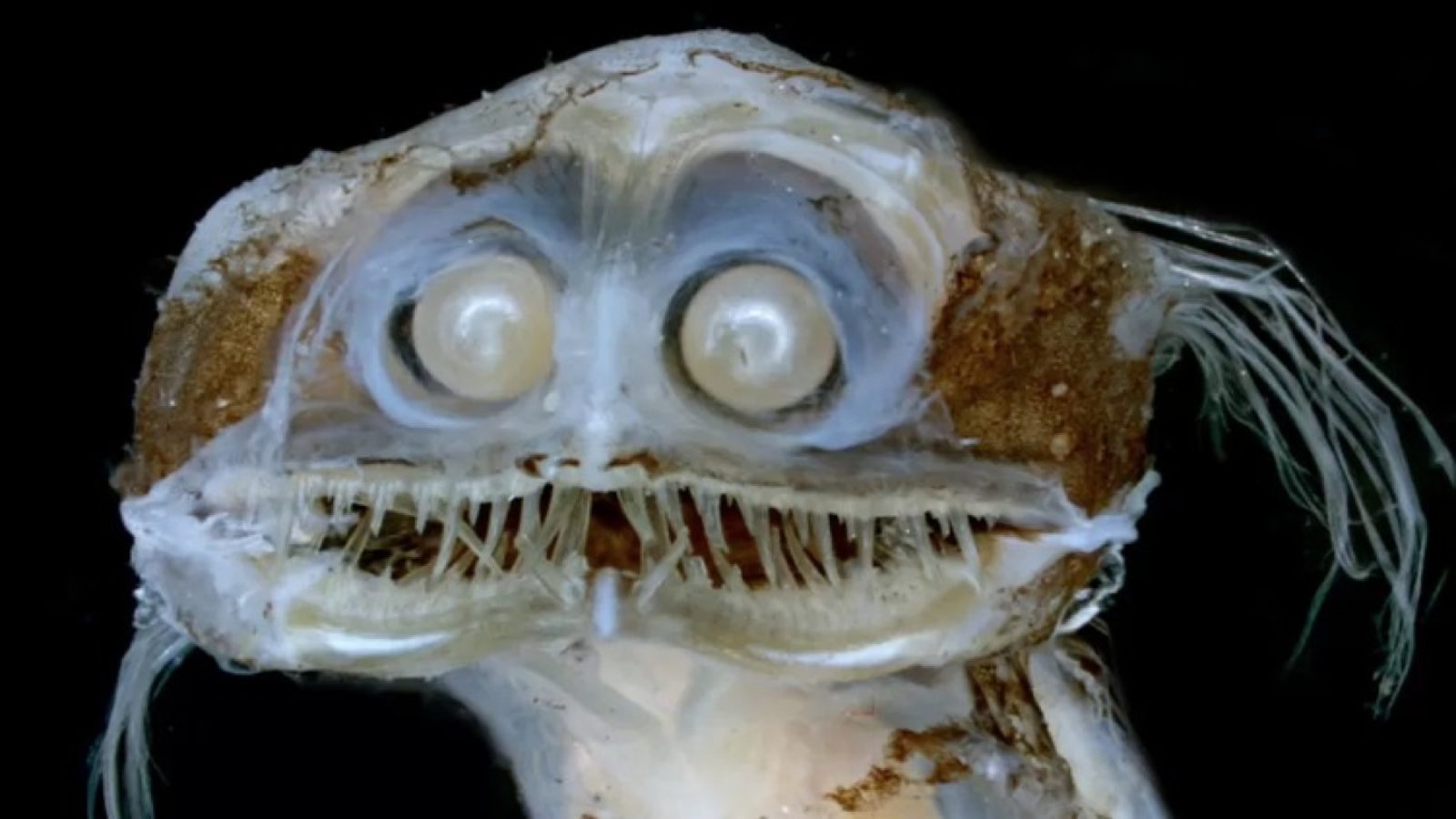

Deep below in the darkest depths of the ocean, where sunlight never reaches and pressure would be fatal to most surface organisms, a lovely predator glides unseen through the blackness. The telescopefish (Gigantura) is a torpedo-shaped, silver predator that lives in the midnight zone of the deep sea. While it only reaches a height of up to 10 inches in length, the telescopefish is a successful survivor with unbelievable adaptations that give it a killing advantage in one of the deadliest places on the planet.
Perfect Vision for the Black Depths
The one feature that really makes the telescopefish stand out is its cylindrical forward-facing eyes. These enormous, tube-like organs are particularly well adapted to take in as much light as they can in an environment where light is barely available. Not only do the fish’s eyes respond to the faintest hints of light, but they also have binocular vision, giving it superb depth perception.
This is especially crucial in the deep sea’s constant twilight, where the shape of a cruising by lanternfish or shrimp can be the difference between going hungry and starving. By holding itself standing upright and looking upwards, the telescopefish is able to follow prey swimming in the relatively brighter levels higher up, sensing movement off the surface of the water through the declining ambient light.
A Body With Suitability for Ambush and Effectiveness
The telescopefish has a sleek, scaleless body wrapped in silvery reflective skin that is useful in camouflaging it. Its silver coloration renders it invisible in the dark waters of the deep ocean by predators or prey. Its body is not designed to be speed-based but ambush-based, and it enables it to drift with little movement until attack.
What makes the telescopefish such an even more effective predator is its extremely distensible jaw that can open wide enough to swallow food larger than itself. This is complemented by a stretchy stomach that can digest these big meals, a vital adaptation within an environment with scarce food and limited opportunities. Its teeth are long, pointed, and inwardly curved—perfect for grasping and holding onto slippery prey.
An Elusive Fish Caught on the Oceans of the Planet
Telescopefish live in the tropical and subtropical depths of the oceans around the world, but it is incredibly hard to research them because of where they live. They are generally between 500 and 2,000 meters beneath the surface of the water, in an area called the bathypelagic or midnight zone. It is cold there, as dark as night, and not very friendly to most forms of life.
Although they are ubiquitous across the globe, telescopefish encounters are uncommon. Their bodies are not able to withstand swift pressure changes, and thus few specimens survive being pulled to the surface. The majority of what we do know about them comes from deep-sea trawls, submersible photography, and sometimes preserved specimens.
A Cryptic Life Cycle Still Being Discovered
Little is known about the life cycle of the telescopefish. Like other deep-sea fish, it is thought to reproduce in mid-ocean, discharging eggs and sperm into the water column. The eggs would then drift close to the surface of the water, where the larvae would develop and hatch. In growing, they would migrate deeper in the water.
It is interesting to note that the transformation from larvae to adults is so extreme that even early scientists used to regard the larvae as an entirely different species. The adult stage is completely different from the larval stage, showing just how much more there is to learn about these animals’ youth.
The telescopefish continues to be a favorite icon of the ocean’s unseen miracles. Its science and its high-tech predator tactics provide insight into the ways that life must adapt to survive in the most extreme conditions possible. At the black, hellish bottom of the ocean, the telescopefish’s ever-watchful eye persists—ever alert, ever waiting.