
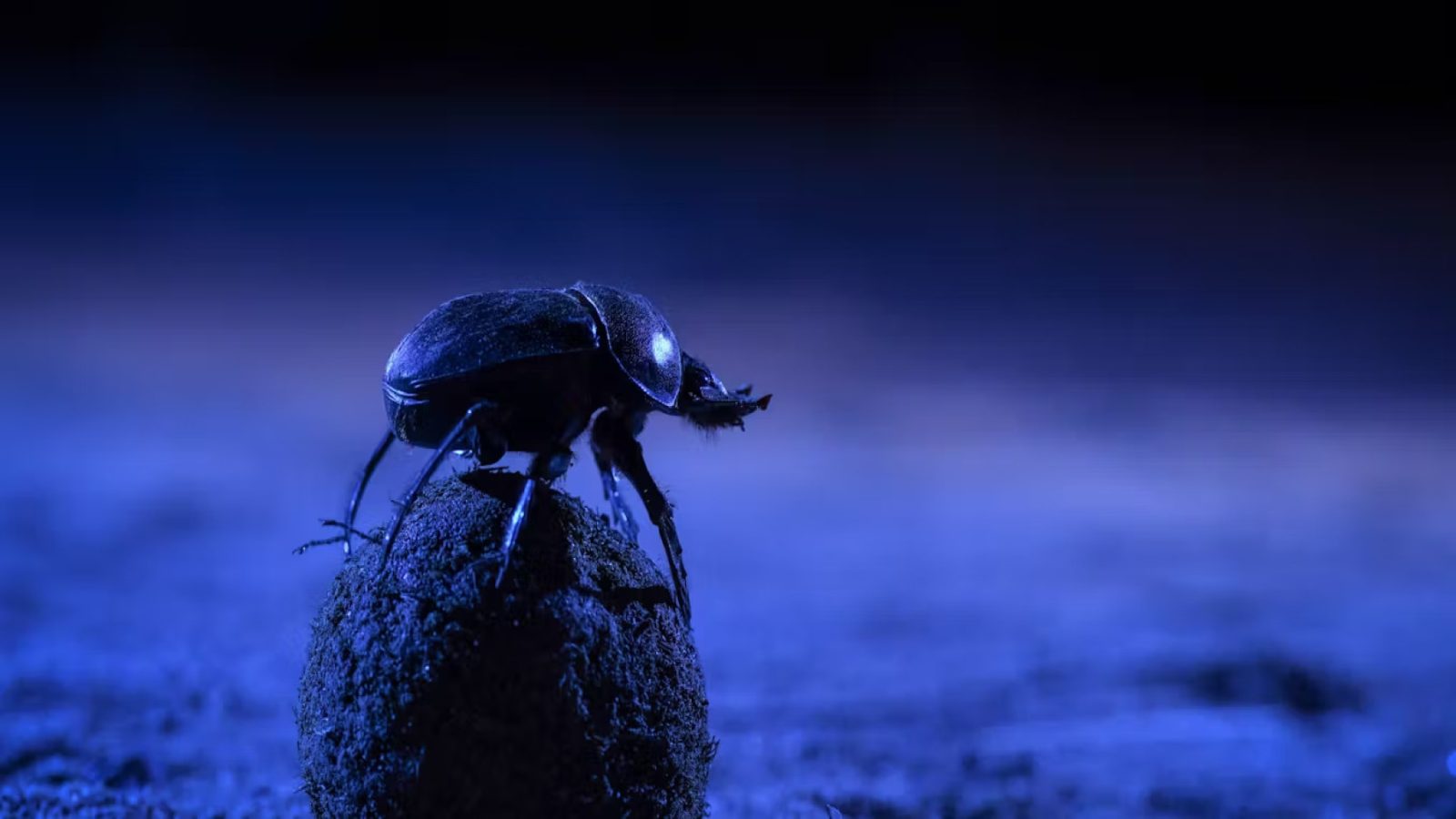

Every evening on the African plains, a humble insect accomplishes one of nature’s greatest feats. Most animals use landmarks or instincts to guide themselves, but the African dung beetle (Scarabaeus satyrus) uses the stars. In 2013, scientists learned that beetles use the Milky Way—the first documented case of any insect using the Milky Way. By using their dung balls carried in straight lines away from the competition, they depend not on the moon or light stars, but on the soft galactic light that stretches from horizon to horizon. It’s an epiphany that doesn’t merely make us love these small animals all the more, but also points to the fragile balancing act between wildlife and the night sky.
The Nighttime Journey of an Unexpected Navigator
Within insects, dung beetles are infamous for their peculiar but inevitable behavior—rolling and collecting manure to serve as a food source or to where they breed. But behind the grime of all this is an extent of navigation ability that left scientists dumbfounded. Researchers Marie Dacke and Marcus Byrne discovered that African dung beetles use the Milky Way’s light to navigate directions at night.
This mechanism enables them to travel speedily and effectively in a straight line away from other dung beetles within the heap, minimizing risk of theft and competition. Even during nights without moonlight, the beetles are never lost, evidence that they are not using lunar indicators but instead the general luminescence of the galaxy. This capacity to remain oriented in complete darkness is how highly developed insect navigation can become.
Planetarium Tests Verify Celestial Navigation
To verify their hypothesis, the scientists developed a series of tests in the field and within a specially constructed planetarium. In the field, the beetles navigated accurately under starry nights but were confused when the horizon was obscured. In the planetarium, scientists simulated various night skies—full of stars to a solitary stripe simulating the Milky Way.
The results were unequivocal: beetles rolled straight paths when only the Milky Way was projected above them. In the absence of all starlight, they rolled in a random pattern. That established that the Milky Way is their major navigational cue, not the moon or individual stars. That degree of accuracy for orientation based on a wide band of feeble light has never before been recorded in insects.
A Glimpse into the Intelligence of Insects
Until recently, complex celestial navigation has been assumed to be the domain of migrant birds, sea turtles, and some mammals. That it should be possible for a beetle whose brain is no bigger than a sesame seed to do so was unbelievable even to old-time entomologists. These beetles employ special polarized light receptors in their compound eyes, capable of sensing polarized light and weak star gradients.
The relevance extends to beetles. If one insect can read the Milky Way for navigation, others may use similar methods unknown as yet. It questions our assumptions regarding the cognitive limits of small animals and opens new possibilities in the study of insect orientation and sensory biology.
Light Pollution Is a Growing Threat to Celestial Navigators
This accomplishment also identifies an increasing problem: the erosion of dark skies by man-made light pollution. Man-made light from towns, roads, and cities is overpowering the stars, including the Milky Way, across much of the globe. For animals like the dung beetle, which use the light of the sky to live, this can be catastrophic.
Without the view of stars, beetles can become disoriented, lose access to resources they require, or be driven down perilous or useless paths. The effects on the environment reach far—dung beetles are vital decomposers, enriching the soil and recycling nutrients. Their loss would result in a multiple times greater effect than their own species. Saving the natural night sky isn’t merely an astrological issue—it’s one of ecological survival.
Initiatives to limit excessive lighting and create dark sky preserves can become a defense not only for astronomers but also for animals that do have the night as an ever-reliable compass. Conserving darkness, we conserve ancient reflexes preceding our own navigation technology.