
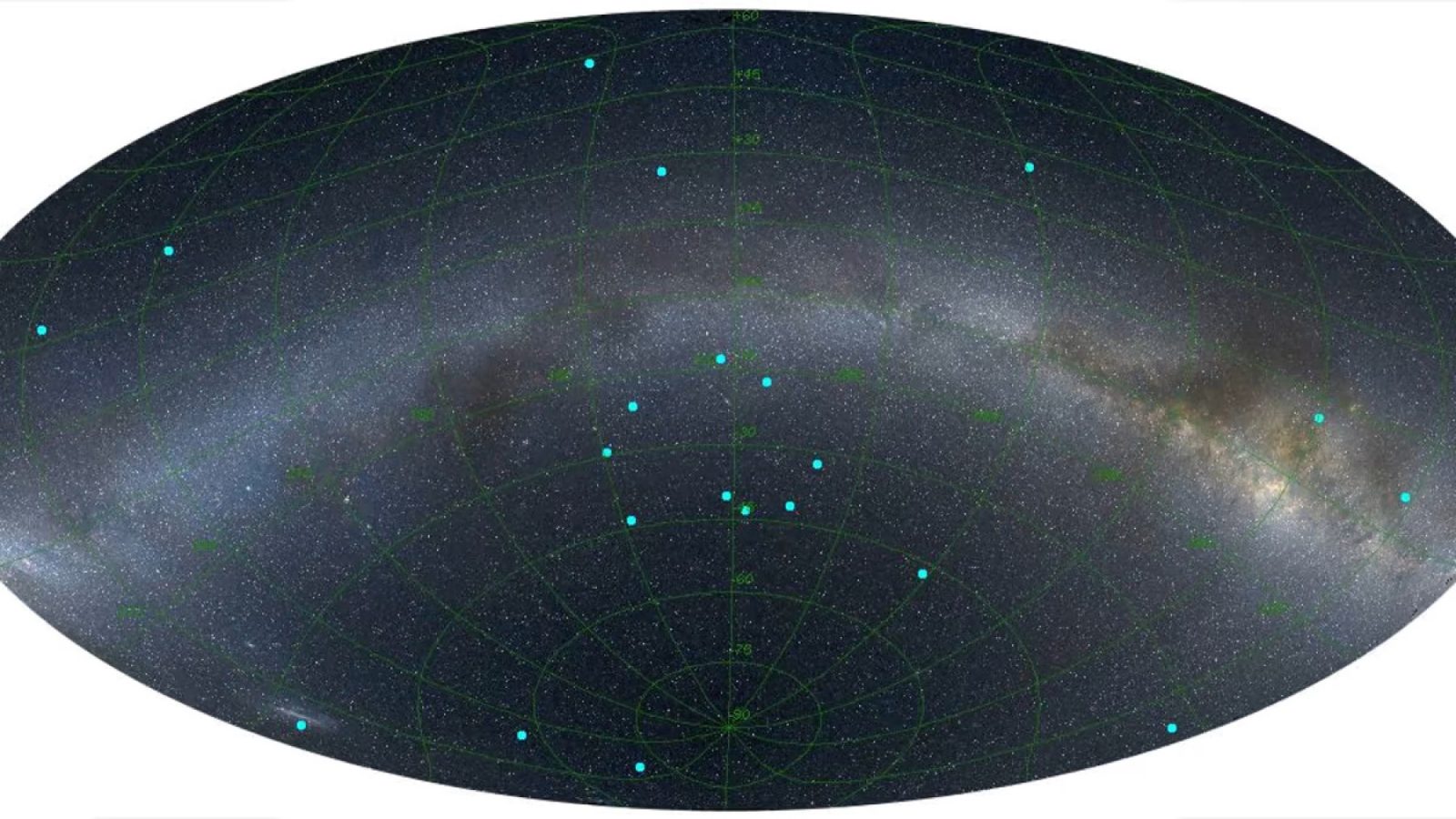

In a groundbreaking discovery, scientists have discovered a massive, ring-shaped structure in space, fittingly named the “Big Ring.” Spanning an astonishing 1.3 billion light-years in diameter, the structure defies current cosmological models and leads researchers to question the fundamental laws of the universe’s design.
A Colossal Find from Deep Space
The Big Ring was discovered by University of Central Lancashire PhD student Alexia Lopez in her research of Sloan Digital Sky Survey data. By looking at light from distant quasars, Lopez found an unusual pattern: almost a perfect ring of galaxies and clusters of galaxies. This galaxy is about 9.2 billion light-years away, and thus the light we are seeing today set out on its travels when the universe was about a half the current age.
What is more interesting about this discovery, though, is how close it is to another structure nearby, a giant structure called the “Giant Arc,” found by Lopez two years ago. The Giant Arc is more than 3.3 billion light-years in diameter and only 12 degrees away from the Big Ring in the sky, and this implies a relationship between these two vast structures.
Challenging the Cosmological Principle
The presence of the Big Ring is a major embarrassment to the Cosmological Principle, a fundamental assumption of cosmology that maintains the universe is homogeneous and isotropic on large scales. If this principle is adhered to, matter would be uniformly distributed if considered over vast cosmic distances.
But the Big Ring’s huge size and organized design conflict with this view. Normal cosmology models propose that clusters over about 1.2 billion light-years in size cannot be included in the universe because there has not been adequate time since the Big Bang for such enormous clusters to form through gravitational attraction alone.
The existence of the Big Ring, then, suggests that our present knowledge regarding the structure of the universe on large scales may be incomplete or in need of refinement.
Theories That Might Account for the Presence of the Big Ring
When this was discovered, scientists have been investigating other hypotheses which would explain the creation of such giant structures. One of these is cosmic strings—theoretical one-dimensional topological defects in space-time that could have formed during the early epochs of the universe. The strings could have been gravitational seeds, around which matter accretes to create the Big Ring’s giant structures.
There is also another theory that assesses the concept of Conformal Cyclic Cosmology (CCC), proposed by Roger Penrose in physics. CCC suggests that the universe goes through three-dimensional death and rebirth in an infinite cycle, and each “aeon” would leave an imprint on the next. Formations like the Big Ring could then be remnants of a previous universe cycle in this case.
Although these hypotheses are conjectural, they produce the demand for fresh models and ideas to explain observation inconsistent with the prevailing cosmological model.
A New Frontier in Our Understanding of the Universe
The existence of the Big Ring has deep implications on the meaning of the universe. If there are structures as large and ordered as these, then it means that the large-scale structure of the universe is more complicated than what was originally conceived. This might prompt revisions in current cosmological models and give rise to new hypotheses regarding the evolution and development of cosmic structures.
Additionally, the fact that the Big Ring is so close to the Giant Arc brings into question whether or not these are somehow related structures. The question becomes whether they are part of something even greater and unexplored. And if so, it becomes challenging to accept a relationship of uniformity for the universe and introduces new parameters of research into the cosmological design.
As the universe becomes more explored by astronomers with newer telescopes and analytical tools, discoveries such as the Big Ring are a reminder that there are still many secrets to the cosmos. Every new discovery not only adds to our knowledge but also is an invitation to challenge and hone the basic assumptions of cosmic creation.