
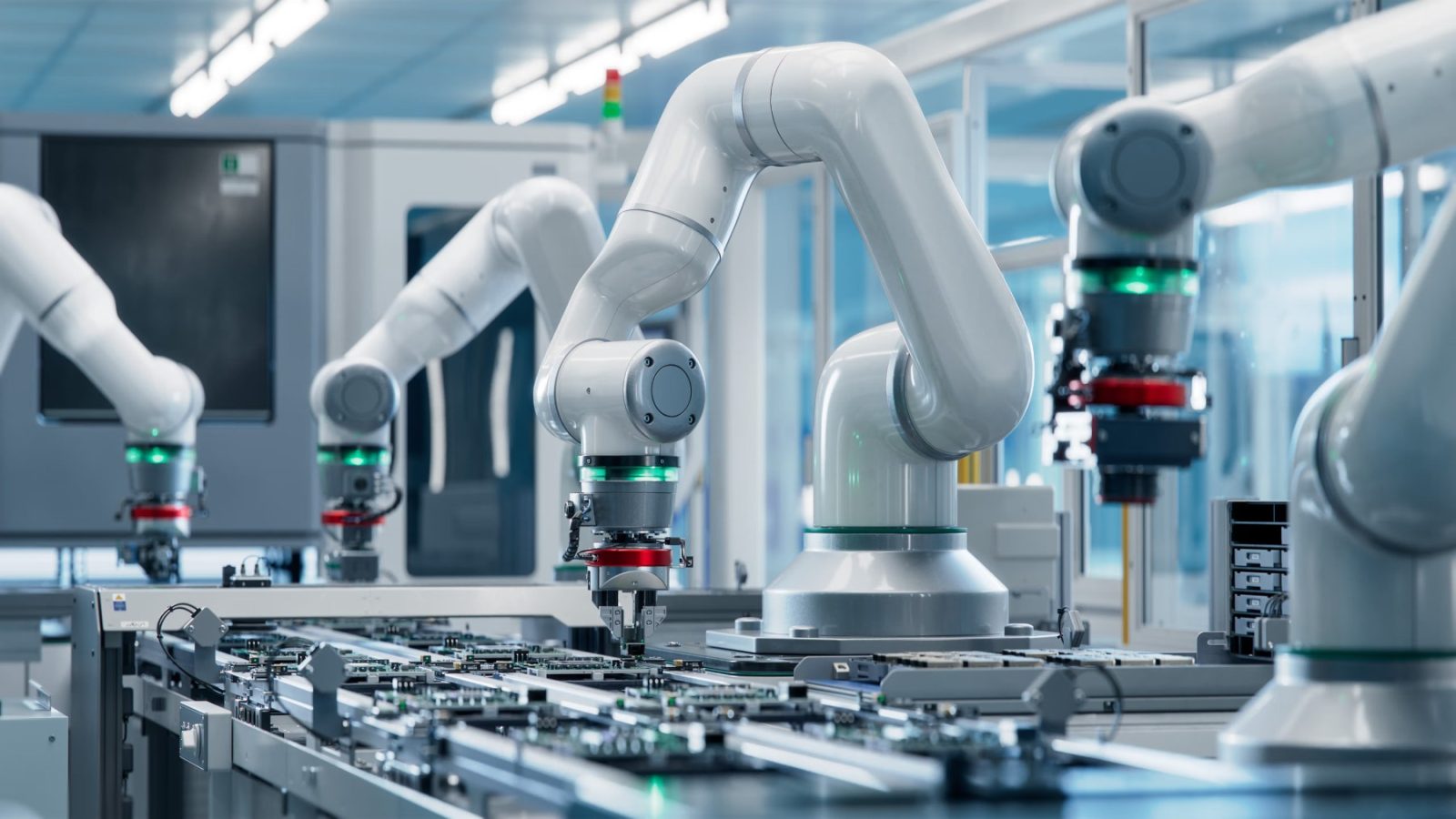

China is leading the revolution in transforming global manufacturing with the rise of “dark factories”—robotic, 24/7 production halls with no human employees or even lighting required. Next-generation factories, fueled by artificial intelligence (AI), robotics, and the Internet of Things (IoT), are able to automate the whole production process. No lights. No breaks. No humans. Just continuous, high-precision output. This is bold innovation in manufacturing efficiency, sustainability, and scalability—and it’s already underway.
The Technologies Powering These People-Free Manufacturing Hubs
Dark factories or “lights-out” manufacturing systems are factories which run without any human presence. They don’t require illumination or climate control equipment or other infrastructure accommodating people. This makes them leaner, more energy efficient, and less prone to mistakes. Dark factories use AI to make real-time decisions, robotics to execute physical work, and IoT networks to schedule tasks between each station on the shop floor.
Such a plant is a Chinese phone factory where robots produce, test, and package phones at rates and accuracy that no human workforce would be capable of achieving. These factories not only economize on operating expenses but also minimize flaws due to human fatigue or inconsistency. The outcome is completely mechanized production lines that operate quicker, cleaner, and more precisely.
Dark factories are founded on a system of interconnected technologies that operate in harmony to maintain their operation perpetually. AI processors, traveling at speeds close to the speed of light, drive logistics and allow millisecond adjustment of production. Robotics manage material transport, soldering, welding, as well as delicate operations such as micro-assembly. Sensors, integrated into all equipment, supply instantaneous data to central AI nodes, where autonomous quality assurance programs and predictive maintenance cycles are run.
Benefits Beyond Efficiency: Sustainability and Cost Savings
In addition, 5G connectivity enables such devices to talk to each other smoothly so that coordination of a higher order can be achieved without delay. The plants are typically designed modularly so that they can be redirected in a hurry to produce new products, so more flexibility is provided and retooling time is shortened. With no middleman, each aspect of the workflow is optimized for output, accuracy, and readiness.
Dark factories bring speed plus—these are a cleaner, more environmentally friendly way of making things. Since they don’t use lighting, heating, or ventilation for humans, they use considerably less energy. The automated systems reduce waste and optimize resource usage, so these processes are much more sustainable.
Furthermore, eliminating human error means less rework and the production of defective goods, which translates into large cost savings. These plants are also becoming more predictable and consistent, providing a competitive edge for companies in the local and worldwide market. They minimize supply chain disturbance through localization and neutralizing dependency on labor availability.
A Disrupting Force with Worldwide Implications
As China zooms off into robot-only manufacturing, the world has a straightforward option: innovate or die. The advent of dark factories creates serious threats to world labor markets. A million manufacturing jobs might become antiquated, compelling economies to sink money into education and employee retraining.
It also poses ethical and geopolitical concerns. Will openness to robotics and AI widen global inequality? Can former manufacturing hubs compete without adopting such technologies? And as humans are taken out of the loop, who is responsible when machines make mistakes?
These questions underscore the ominous possibilities of this new industrial regime. One thing is certain: dark factories are not an introduction to things to come—nor are they the foundation of a new era of intelligent, unstoppable production.