
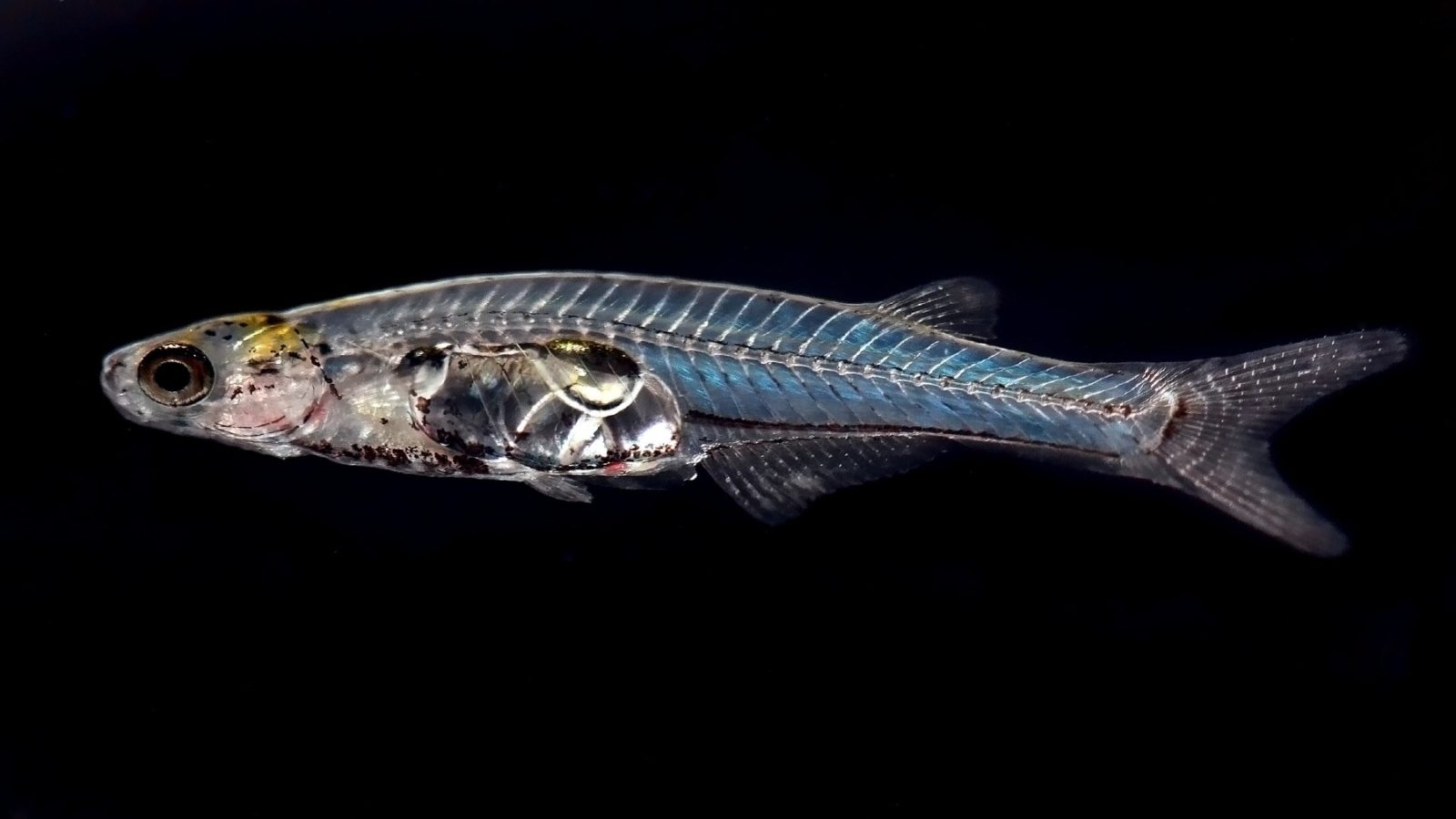

Hidden away in Myanmar freshwater streams is a marvel of the natural world that defies the norm. Danionella cerebrum, a fingernail-sized, transparent fish, amazed scientists with its potential to produce one of the animal kingdom’s loudest sounds despite its tiny size. This tiny marvel, whose almost invisible body belies its remarkable sound-producing power, screams out sounds louder than the trumpet of an elephant—over 140 decibels. Its 2023 discovery has fascinated scientists of biology, acoustics, and neuroscience to witness the magnitude of power one can be contained in the most fragile of bodies.
A Small Fish with a Big Sound
Lurking in the tranquil, clouded creeks of Myanmar’s Bago Yoma mountain range is a very astonishing animal: Danionella cerebrum. Measuring only 12 millimeters long—roughly as wide as an adult human fingernail—this clear fish has defied scientists by producing sounds over 140 decibels. That is comparable to the sound a jet engine makes taking off at 100 meters away. Such an ability makes Danionella cerebrum one of the loudest animals by weight.
The Device behind the Roar
The mystery behind Danionella cerebrum’s thunder boom is in its unique anatomical devices. Scientists found that a specialized sound-emitting device composed of a drumming cartilage, a redressed fifth rib, and fatigue-insensitive sonic muscles was responsible for the boom. By the contraction of the sonic muscle, the latter tugs on the fifth rib, tensing the drumming cartilage. When released, the snap back cartilage and hits the swim bladder with phenomenal speed—decelerating by more than 2,000 times the acceleration of gravity—to create a brief, forceful pulse. Any 2.5-millisecond-pulse can be fired off in quick succession so that the fish is pushed to produce useful sound communication bursts in its context.
Communication in the Shadows
The ecosystems of Danionella cerebrum are in dark waters, which have limited visibility. In this setting, the use of acoustic communication is inevitable. The clicking sound that is audible from the fish is used to fulfill a number of purposes:
- Territorial Displays: Males can utilize the sounds to dominate and demarcate territories.
- Mating Calls: The acoustical calls can be utilized to attract mates.
- Navigation: In murky water, sound can help with spatial navigation and communication with individuals of their own kind.
Surprisingly, experiments revealed that dominant males have the ability to inhibit the production of sound in other male rivals, indicating a sophisticated social hierarchy enabled through sound. This raises intriguing questions regarding dominance hierarchies and communication tactics among small aquatic organisms.
Implications for Science and Technology
Aside from its scientific interest at the biological level, Danionella cerebrum has much to teach other scientific disciplines:
- Neuroscience: As the smallest adult vertebrate brain, the fish is a prime candidate for in vivo brain imaging studies. Because its body is translucent, researchers can view the living brain in action in real time.
- Biomechanics: The ability of the fish to create sound can be used to develop new applications in acoustic engineering and biomimetic design, especially for miniature robots and underwater communication systems.
- Evolutionary Biology: Learning how a small creature evolved to make so much noise informs us about the forces of evolution and adaptation that are needed to survive in sensorily depleted environments.
Essentially, Danionella cerebrum exposes the ability of the world’s smallest creatures to make an enormous impact on our knowledge about nature. By the contraction of the sonic muscle, the latter tugs on the fifth rib, tensing the drumming cartilage. From the bottom of Myanmar in the sea to the core of biological sciences, this see-through wonder informs us that nature’s biggest surprises are likely to come in the most compact package.