
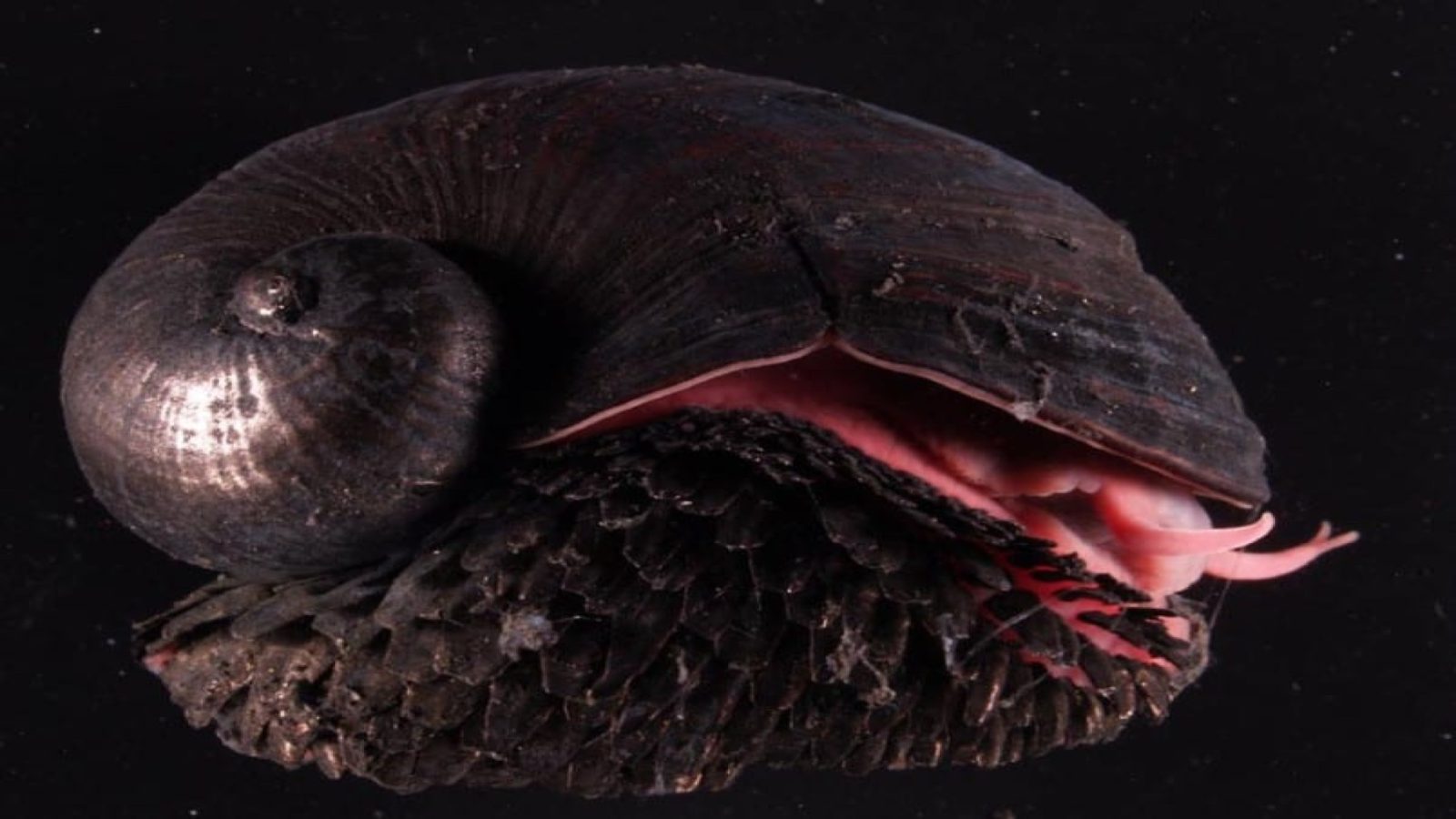

Far beneath the Indian Ocean, where blistering heat and crushing pressure make survival a virtual impossibility, there is one of nature’s most incredible creatures—the volcano snail. Chrysomallon squamiferum is the scientific name for this deep-sea gastropod that lives in hydrothermal vent communities, clinging to life in environments that are closer to those of aliens than anything on our planet. These so-called “snails from hell” are one of the most severe examples of biological adaptation on the planet.
Forged in the Fire: An Iron Sulfide Armor Shell
Volcano snails have arguably the most amazing feature of any mollusk: an iron sulfide reinforced shell, with pyrite and greigite features especially highly developed. The three-layered shell is the only one of its kind in the animal kingdom. The outer iron sulfide layer serves as a shield against predators and environmental damage. Next is a dense organic middle layer that can absorb mechanical stress, and lastly, an inner aragonite layer guards the soft internal tissues of the snail.
This natural armor is not metaphoric—it is real. The iron plating provides a dark, metallic appearance and hardness on the order of industrial materials. These are qualities that are needed in an environment where pressures from all sides can be 250 times the surface pressure and water temperatures at the vents are 400°C. Though they don’t actually carry themselves into the hottest areas, they still weather temperatures that would cremate most terrestrial organisms.
Life on the Edge: Hydrothermal Vents as Home
The home of the volcano snail is also stunning. They inhabit only hydrothermal vents in the Indian Ocean, 2,400 to 2,900 meters below the surface. Hydrothermal vents are cracks in the Earth’s crust where geothermally heated water bursts into the ocean. The scorching temperatures and poisonous chemicals might seem lethal, but to volcano snails, it’s home.
Their existence is facilitated by their proximity to the vent flow from the center. Rather than sitting in the middle of the hottest water, they sit nearby—near enough to take advantage of the vent’s chemical production, but far enough away not to be boiled alive. This perilous balance of being near peril and relying on it makes their existence all the more miraculous.
Eating Without a Mouthful: Microbial Symbiosis
One of the most remarkable things about Chrysomallon squamiferum is the way it makes energy. Unlike all other animals, volcano snails do not eat in the classical sense. They have symbiotic bacteria inside a large specialized esophageal gland. The bacteria carry out chemosynthesis—converting poisonous vent-emitted chemicals such as hydrogen sulfide to organic molecules that nourish the host.
Such symbiosis is prevalent among animals of deep-sea vents, but the volcano snail pushes this further by dedicating most of its internal cavity to house these microbes. Such a symbiotic arrangement eliminates the need for a digestive system and grazing or predator-type mouthparts. This bacterial arrangement is their only connection to life in their sunless, barren world with no plants.
A Species on the Edge: The Dangers of Deep-Sea Mining
Even with their vitality and hardiness, volcano snails now are threatened with a new peril they cannot escape: human exploitation. Their vented habitat is being eyed by deep-sea mining as its next target since so many valuable metals and rare earth elements lie there. These operations will likely eradicate the only known habitats of these amazing snails, leaving it too late to reverse the damage.
In response to such danger, scientists and conservationists are calling for legal protection and ecologically sound ocean management. Chrysomallon squamiferum is included in the list of threatened species by the International Union for Conservation of Nature (IUCN) and is among the limited deep-sea invertebrates officially declared as threatened. Their very existence is reminding us of the vulnerability of ecosystems we are just starting to discover.