
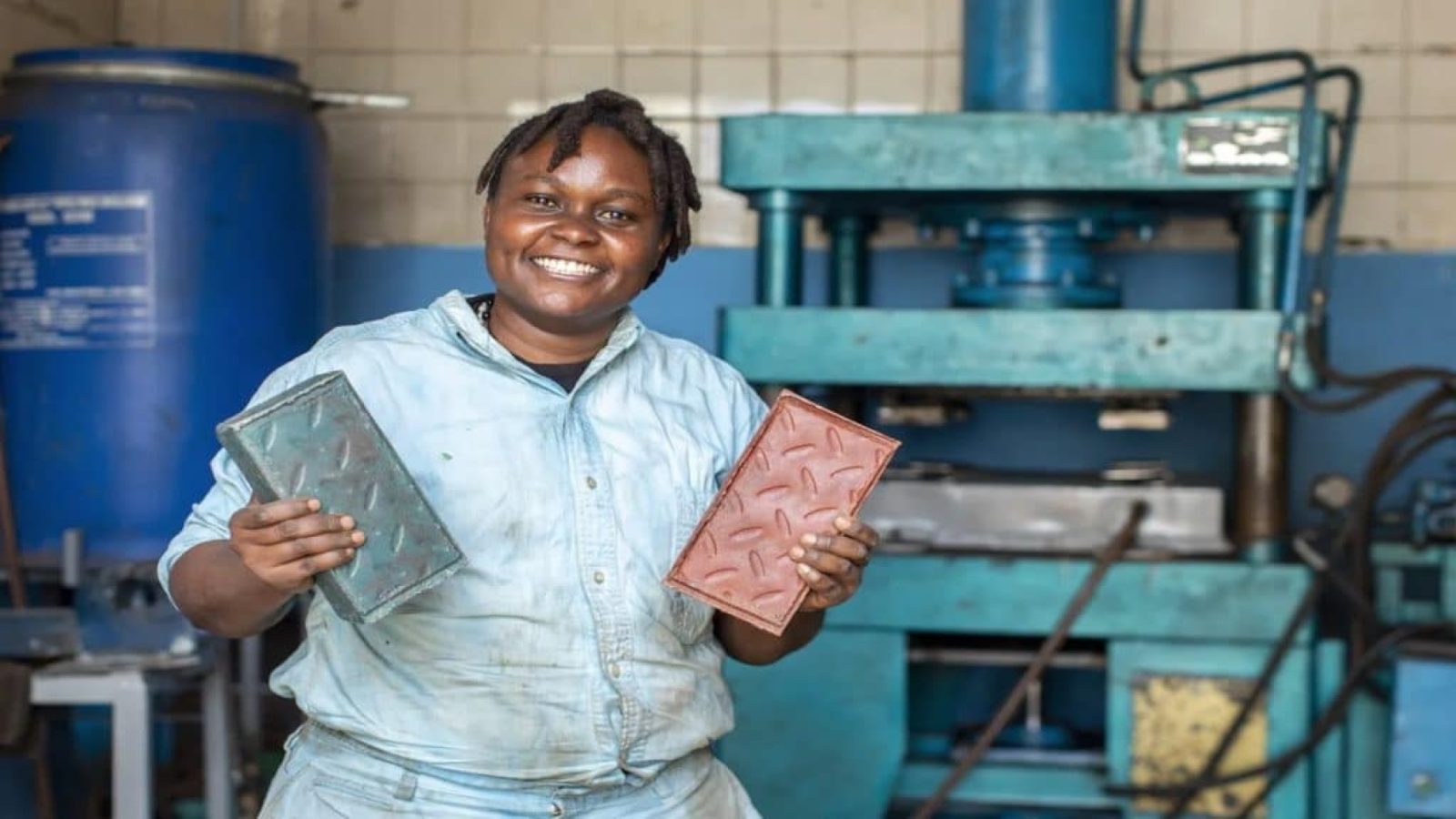

In the heart of Nairobi, Kenya, a groundbreaking innovation is transforming the perception of waste, building, and sustainability. Nzambi Matee, a materials engineer with a dream to positively impact the environment, is the founder of Gjenge Makers, a business that turns plastic waste into durable, inexpensive building bricks. Her invention addresses two real-world issues at once: rising plastic pollution and the need for affordable housing materials. With her creativity, Matee is constructing not only bricks—but a sustainable and cyclical tomorrow.
Backyard tinkering to industrial ingenuity
Nzambi Matee began her odyssey in 2017, when she quit working as a data analyst to dedicate herself to finding a solution to the challenge of plastic waste. With an education in materials science, she established an outdoor laboratory in her mother’s backyard and started testing mixtures of sand and different plastic shapes. Through a series of months of trial and error, she was able to produce a plastic-sand composite material that was not only soft, but five to seven times stronger than concrete.
By 2019, Matee had also designed her own brick-making machine to increase output. The outcome? A process that converts easily accessible plastic waste materials—like high-density polyethylene and polypropylene—into light, durable, and affordable bricks. What began as an individual project quickly became an upstart business.
Gjenge Makers: A Model for Eco-Entrepreneurship
Gjenge Makers is not just a factory—it’s a vision of what innovation can be in the midst of climate change. Based in Nairobi, the company recycles more than 500 kilograms of plastic scrap daily. Practically all but a tiny proportion of this plastic would otherwise go to rivers and oceans or landfill. Instead, it gets sorted, shredded, melted, and pressed into colored blocks of different sizes.
These bricks are utilized throughout Kenya for pavements, schools, houses, and other constructions. The product is durable, weather-resistant, and considerably less expensive than conventional materials. Translating environmental issues into economic opportunities, Gjenge Makers utilizes waste as a resource.
In addition to the environmental concern, the business is also hiring hundreds of individuals, mostly women and youth. Construction workers, machinery operators, and sanitation men are all involved in the value chain beginning with garbage and progressing to life-changing projects in society.
International Recognition and Local Impact
Nzambi Matee’s work hasn’t escaped attention. She has been internationally recognized for her work, including being the United Nations Environment Programme’s Young Champion of the Earth for Africa. But her real impact is at the local level. Every brick she places is one that makes a more resilient structure and enables individuals to live in improved, safer housing.
She has also become a science and young African woman entrepreneur role model. She is an example of how the solutions to the problems of the world need not necessarily be found in large companies or sophisticated lab setups. They may begin in a backyard, with a vision, and an unrelenting drive to fix a problem.
Plastic Waste is Not the End — It’s a Beginning
Gjenge Makers is a new way of thinking as far as waste and materials are concerned. Instead of seeing plastic as the ultimate last resort, Nzambi Matee sees plastic as the start of something useful. Her bricks are not just building blocks—they are evidence that usefulness and sustainability can coexist.
With a world ever more pollution- and climate change-burdened, Matee’s product is a testament to the potential when innovation and intention are allowed to come together. With every sidewalk laid and every school constructed out of her bricks, she’s screaming from the rooftops a message: the future isn’t just green—it’s circular.